
For Carers Rights Day 2026, the Dementia Trust reflects on why recognising our caring roles can change lives.

Years ago, when I was running a local Age UK charity in rural England, I had the privilege of sharing Christmas lunch with four people in a lovely, cosy country pub. Two married couples who, until fairly recently, had been complete strangers.
The two men had met through one of the local Age UK clubs for people living with dementia and their carers. Both were caring for their wives, who were living with dementia, although their experiences were very different.
One of the women was constantly getting up from her seat, becoming verbally aggressive and clearly finding the whole experience rather difficult. The other sat happily giggling, smiling at everyone and seemingly enjoying every minute of our Christmas lunch.
As I sat with them, what struck me wasn't just the differences between the two women, or the challenges their husbands were navigating, but the extraordinary friendship that had developed between these two men.
They had quite literally got each other's backs.
They understood things about each other's lives that other friends, however well-meaning, probably never could. They shared advice, practical help, humour and, I suspect, the occasional moment of despair. They had found someone who understood what it meant to love a person whose needs and relationship with them were changing.
And none of this would have happened if they hadn't first recognised something important. They weren't simply husbands doing what husbands do, they were carers too.
That recognition had opened the door to a local club, to friendship and to support that was making a real difference to their lives.
I have never forgotten that Christmas lunch.

Someone you know is a carer, but do they know it yet?
That is the question at the heart of this year's Carers Rights Day, led by the wonderful organisation Carers UK.
And it is a question that matters to all of us, whether we are currently caring for someone or not.
Research from Carers UK tells us that the average person has a 50:50 chance of having cared for a family member or friend by the age of 50, long before most of us are thinking about retirement.
Think about that for a moment. Half of us will have experienced caring by the time we are 50.
Yet many people don't recognise themselves as carers. They are husbands, wives, partners, lovers, brothers, sisters, daughters, sons, parents, friends or neighbours. They are doing what needs to be done, often gradually taking on more responsibilities until their lives have changed beyond recognition.
They may be managing medication, juggling appointments, dealing with finances, providing emotional reassurance, getting up several times during the night or worrying constantly about someone else's safety and wellbeing.
And because they don't see themselves as carers, they may never think to ask for help.
Knowing you are a carer can change your life
At the Dementia Trust, we believe passionately that life should not stop being a good life simply because you are living with dementia or caring for someone who is.
But we also know how easily caring can become overwhelming, particularly when people are trying to manage everything themselves.
For some, the consequences can be devastating. Careers interrupted or abandoned, savings depleted, friendships lost and physical and mental health deteriorating. Loneliness, poverty and depression are not inevitable consequences of caring, but they are very real risks when people are left without the right support.
And sometimes it isn't one enormous crisis that brings someone to their knees. It is the accumulation of hundreds of smaller things, day after day, with nobody recognising just how much they are carrying.
This is why identifying yourself, or being recognised by someone else, as a carer matters so much.
Because knowing you are a carer is the first step towards knowing you have rights. And knowing your rights can open doors you didn't even realise existed.
It might mean getting a carer's assessment, or an Adult Carer Support Plan in Scotland, which helps identify what support you need in your own right. It might mean speaking to your employer about flexible working or taking carer's leave, finding out whether you are entitled to financial support or benefits, or making sure your GP knows about your caring responsibilities.
It might mean finding a local carers' organisation where someone can help you navigate the health and social care system, or a small grant that enables you to take a break, enjoy an activity or simply do something for yourself.
And it might mean finding a peer support group, where you meet someone who understands your life without you having to explain every detail.
Someone like those two men at the Christmas lunch.
None of these things necessarily solves all the challenges of caring, but together they can make an enormous difference. They can help someone stay in work, maintain their health, keep friendships alive and retain a sense of who they are beyond their caring responsibilities.
Sometimes the difference between coping and crisis is not one big intervention, but several small pieces of support arriving at the right time.
There are some brilliant organisations out there. Please use them.
One of the things I have learned over many years working alongside carers is that asking for help can be surprisingly difficult. People feel guilty, think someone else needs the support more, or simply don't have the energy to start finding out what might be available.
But there are some brilliant organisations that genuinely want to help, and you don't need to wait until you are desperate to contact them.
Carers UK provides excellent information about your rights, benefits, employment and the practicalities of caring, as well as opportunities to connect with other carers.
Carers Trust can help you find local carer support organisations across the UK. Many offer advice, peer groups, activities, wellbeing support and opportunities for a break. What is available varies locally, but finding out what is on your doorstep is a very good place to start.
And if you are supporting someone living with dementia, I would particularly encourage you to contact Dementia Carers Count, another fantastic charity offering specialist advice, emotional support and opportunities to connect with other carers.
Please don't assume that because you are managing today, you won't need support tomorrow. And please don't assume that the help isn't meant for you, because it absolutely is.
And while you are looking after someone else, don't forget your own future
There is another important part of this conversation, and it is one that we are particularly passionate about at the Dementia Trust.
When we are busy caring for someone else, it is very easy to put our own lives, health and future plans on the back burner.
But what would happen if something changed for you? If you became seriously ill, had an accident or found yourself unable to make decisions about your own affairs?
Who would be able to help, and would they have the legal authority to do so?
This is why we launched Planning Ahead, our Power of Attorney campaign, working alongside legal partners across Scotland.
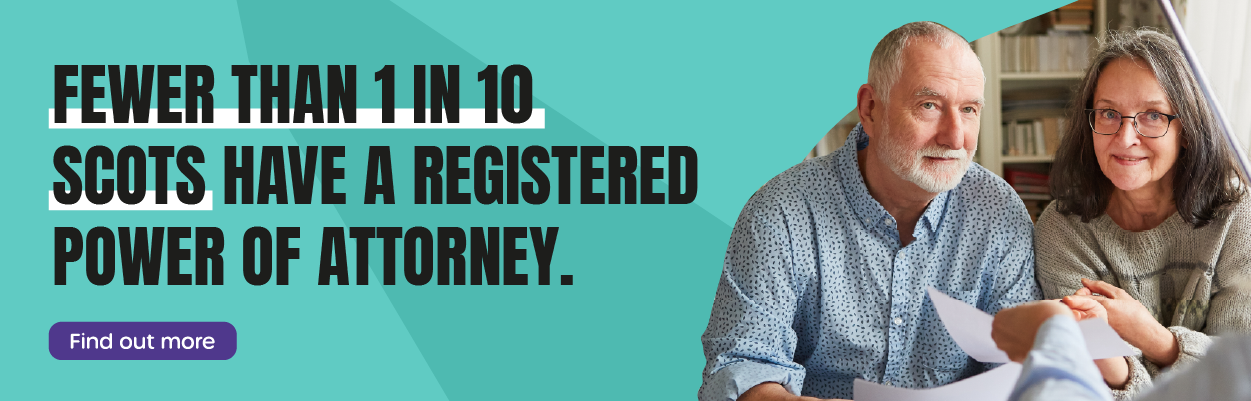
Only 9% of Scottish adults have a Power of Attorney. That leaves an awful lot of families potentially facing unnecessary difficulties at precisely the time they can least cope with them.
A Power of Attorney allows you to choose people you trust to make certain decisions on your behalf if you need them to. It is something to arrange while you have the capacity to make those choices yourself, rather than waiting for a crisis.
We often talk about caring as something we do for other people, but planning ahead is also a way of caring for those who may one day need to help us.
It is a gift you can give your friends and family, and one that could make everyone's life, including your own, considerably easier.
As we launch the next stage of Planning Ahead on 20 November 2026, ahead of Power of Attorney Month in February 2027, our message is simple: don't put it off.
Visit the Dementia Trust's Planning Ahead campaign, find out more and take the first step towards arranging your Power of Attorney with one of our Scottish legal partners.
One conversation could make all the difference
I often think about those two men and their Christmas lunch. I wonder how different their lives might have been if they hadn't met, if nobody had encouraged them to come along to the club, or if they had continued to think of themselves simply as husbands who should be managing everything on their own.
Their friendship didn't take away dementia or the difficulties they faced, but it gave them something enormously valuable. Someone alongside them. Someone who understood. Someone who had their back.
And really, shouldn't we want that for every carer?
So, this Carers Rights Day, perhaps the most important thing you can do is start a conversation.
Think about your friends, family, neighbours and colleagues. Is someone quietly doing more and more for another person without recognising that they have become a carer? Are they missing out on support, advice, financial help or simply the chance to meet someone who understands?
Maybe you could be the person who helps them make that connection.
Because recognising someone as a carer isn't about giving them another label. It is about opening a door to support, friendship, rights and the possibility of a better life.
And, as I learned over Christmas lunch all those years ago, sometimes what is on the other side of that door is something rather wonderful.